how I got a job + current experience of unemployment in 2026
Oct 7, 2026
It is 16:43 on 5th of October and I just got offered a job this morning. It has been 10 whole months of unemployment. It's been a hard journey and I'd like to share that experience and give a reality check + advice maybe? you and I will both discover all the ugly feelings I've bottled up and ready to pour into this blog post because there are many les miserable shaped feelings here.
I started my break in December, extremely hurt and confused. I'd resigned from my previous job just short of 7 months, I'd cried everyday at the end and my health was failing me. The last day of the job I puked twice in the office before having a colleague bring me home because I almost blacked out from the pain. I slept a lot for the next three months. Post the three month mark in February, I still couldn't sit down and do anything at all. I knew I was due for a psychiatry appointment because this was the worst executive dysfunction I'd almost ever faced. Post a few appointments, I had an unprepared diagnosis for autism. I knew all my life but this was out of the blue. I accepted it, tried a few drugs that finally kickstarted my system and whoops, 6 weeks later in the ER for gastroenteritis. Love it. Had to stop the medication but I did notice an up in productivity, the productivity stayed.
I started revamping my portfolio site. It was not a bad site but it could be better, it was handcoded and very of whatever my skills were at the time and then I started making a killer site, many elements I added to it went viral. One of them was this bookshelf project. I was already using AI to make things and learning html, css and javascript on the side for years (I also wanted to and still want to transition into a design engineer role - optimise performance, beautiful motion and everything shipped in code. I was actively tweeting about it, reaching out to people and being very very receptive and communicative about this. But still no job. Heck, there were no job interviews even.
That's when I realised, this will not be an easy time period. I was used to being almost poached from companies, when I was having a good time, shipping things with big impact numbers. So, this was very very new and at some point, the depression started sinking in.
This particular job interview that I cracked was 10 rounds long, spanning 4 weeks - portfolio walkthrough, whiteboarding, UI + AI prototype (split into 2 rounds in the whole day), round with the PM, round with CPO, round with CTO, HR culture fitment round, HR compensation call when everything went well.
I got this job via a friend who was at a startup advocating for me, we were good friends and he'd been wow'd by some work he'd already seen.
I spent quite a long time reading everything they do, it was B2B so I wanted to know everything they did, their value proposition, the words they used internally and speak to them in the language they understood
There is a general expectation now to show agentic AI work here, thankfully I'd done a small project earlier that could be showcased here. The friend was very honest about his communication "They want agentic AI work and they want large scope projects", I had to keep my big number project walkthroughs aside for a more curated walkthrough that the company understood. These were portfolio walkthroughs that worked well "great narrative structure, storytelling and numbers to back it up" was the feedback and the bet paid off. The questions were great and the conversations went deep and I got to show off my product thinking skills by talking about why I chose one UI/UX over another, what we chose to measure and why the project mattered for the business. I also took the time at the end to show my side projects which I was very very proud of.
Another indicator that you won't make it to the next round is when people will not bother asking questions or hearing you out. And that happened a lot.
For the next round, I was asked to come to the office for the whole day.
A PM got on a call with me first thing, introduced himself, talked about the company and asked me lots of questions about design. How I solved problems? What mattered the most to me when deciding? How did I make difficult calls? When did I fail last and how I learnt? What is my current design process? And so on for 45 mins. I tried my best to use their own company examples (for example - lets say {insert user persona that uses said company product} is trying to accomplish {common task performed by said user persona}, here's how I'd go about it). Being specific and making the specific details about the company makes you someone familiar to them. And that really matters. The call was great.
We broke for lunch. And you best believe I took the designer on the team to a round about the office for a post lunch walk. I asked about his process, company tidbits and his stance on AI. I will write later about my thoughts about AI.
So now I had to do the delicately walk the line of "I don't do everything with AI" but also "I know how to use AI but I have my own brain and an sacred artistic process"
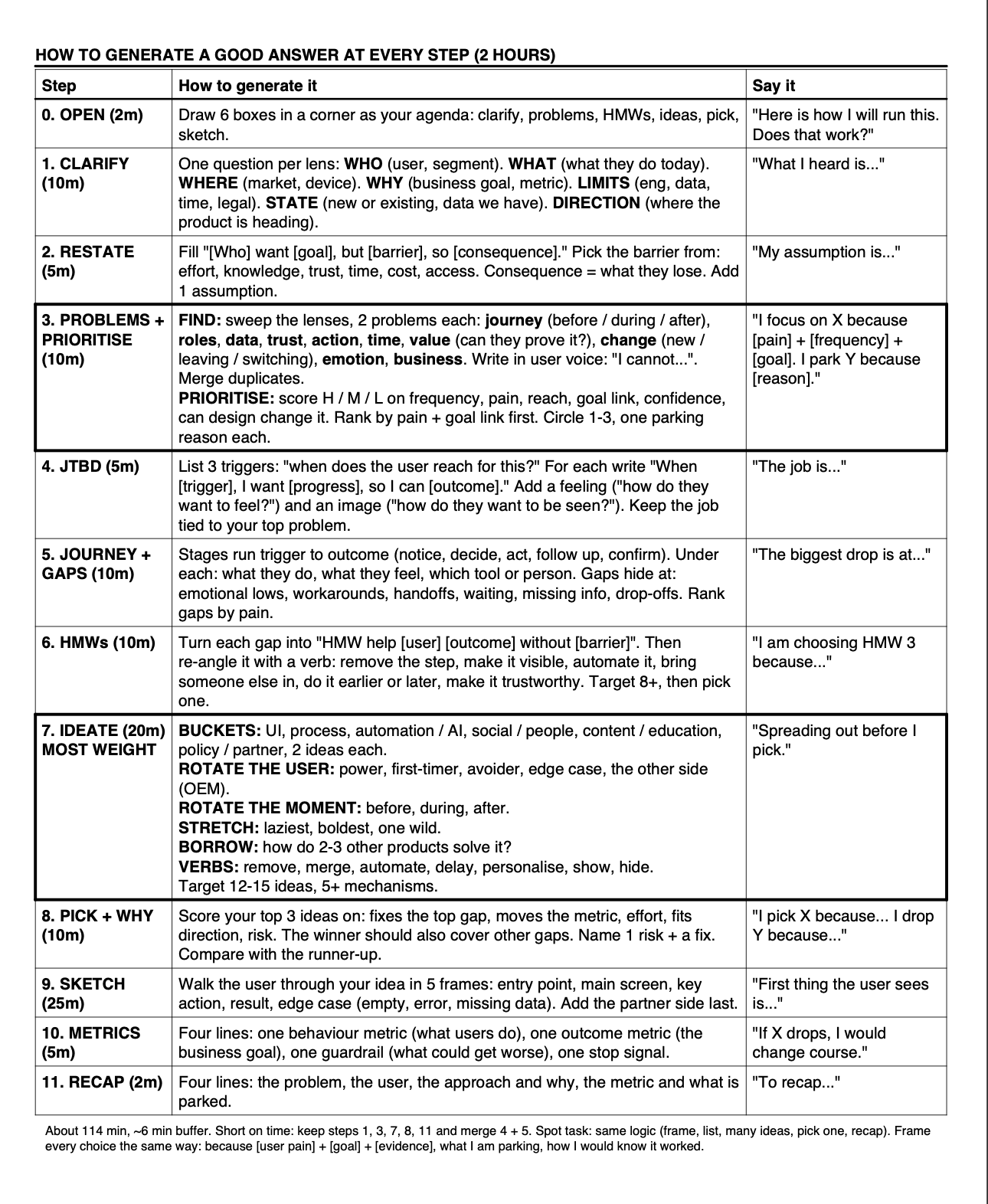
Design process, here we come. The problem was vague and their own company's product. Ok, I have to play by my strengths, I don't know everything about this company so the solution will not be as good as what they've come up with, but I do know these. I ask great questions, I can identify gaps and I can come up with many many solutions that I will further interweave into a complex solution that hits many pain points. I wanted my systems thinking to win over my lack of experience with the users and product. That's what I did. There were three people in this round - A technical lead, A PM and a designer. And yeah I did well. Here's a cheatsheet I prepared to help revise before the whiteboarding round so I remember to do the important steps.
general questions about product thinking here. But I fumbled one question "What kind of users do you like to design for?" My answer was centered around making data density easily consumable. But I know I fumbled that question. The real answer for me is people - flawed people with ADHD that forget things, with autism that like the predictable interface that stays the same. And family centered people that just want to get done with work and go home.
I could see this conversation coming from a mile away, because if you saw my resume you'd know I've never stayed in a place for more than a year. I've been laid off, two companies acquired and one I left because my product didn't go live after 8 months of working on it, it was a difficult call.
And the question arrived. The PM interviewing me pulled me aside at the end and asked me "what do you think you want to be in like 5 years?" I'd practiced this "I know that it takes a long time to get to know users and business to make impact, I'm looking to stay for a while and grow within the company", "what kind of growth trajectory are you interested in?", "I'm going to be honest here, managerial roles are not very sought out anymore due to AI and I'm looking to take the IC route for as long as I can, help the team grow, ship things and mentor people on the side while I can"
I did everything I could. I was told I did well and somebody from the team would reach out to me soon
To my surprise, we were apparently only halfway done. And I was invited yet again for another full day office visit.
What the... What even is that? I asked the HR what it was and she said "we couldn't test your UI skills during the earlier round so we'll be testing that, this will also be for the whole day"
The prompt here was also company's product and a continuation from the previous whiteboarding conversation
Here I was asked in the first half to not use AI at all in the first half, make wireframes and then convert it to UI in the second half using AI. I see.
I did my usual research questioning here and I was met with "do what you think is best" I was supposed to figure out everything about the product and design everything in silos. I used google here to find more about persona. Made wireframes on figma and ran it through the team once and broke for lunch.
Lunch was ok, I ate less because I didn't want to be sleepy and chatted with the team.
They'd provided their own api keys to use kimi and it was supposed to be used in the terminal. Now I have done some work in the terminal, I know how to use it somewhat but not fully. And the biggest problem with the terminal is that I can't take screenshots and debug UI. And that is the most important part of design. I just hoped to god I figured it out and I was thankful to be around other engineers that used AI constantly like Dhruva & Atharva who taught me things by force and osmosis.
And then the horror, I connected the figma MCP and Kimi is.... slow... 20 mins pass, 45 mins pass. At this point I asked Kimi to stop, tell me everything it was doing and I quickly realised it was building a whole design system and for some reason writing backend??? even though I mentioned its a simulated design exercise. Oh crap, system design, it assumed it was system design and not product or UI. Lord, ok now I work with what I have. I was more detailed this time on the goals and everything it had to build. Used "grill me" skill to make sure everything being built was vouched for. And then thankfully 10 mins later it had something cohesive. A lot of my portfolio is very interactive and I wanted to have interactive elements here and make sure things had life. I built 4 screens and all of them had okay UI and motion.
The call also included the PM asking me to pick apart some of the unaddressed problems in the prototype and quickly brainstorm with him. Which I did. I did well on one and the other he had to prompt me to get the answer he was looking for.
I was tired and it was 4PM
I knew this was coming. I understand the concerns and he asked me "We spend a lot of resources on people here, we want to make sure our goals are aligned" I reassured him I was planning on staying and growing with the team here(I fully am. I want to stay and grow and make beautiful things). That was a 45 mins call.
If you're in bangalore, you'll relate to this. I travelled back home in metro and then tried to take a rapido back home and it took me 25 mins to get a ride and 15 more mins for the ride to get to pick me up. I was dead. I went home and cried. Partly for how long the ride was and partly for how my career had spanned out. I love my job, I love design and I love seeing people use what I make. I love collaborating with people (both PMs and users) and I love knowing how people think. These last four years have been hard because of the market.
I was warned by my friend that this would be very thorough, that meant more questions on my resume and many more STAR framed answers. The HR had a lovely accent and I put one on without realising and I kept thinking how do I transition out of this accent without her realising this. My heart sinks whenever I look at my resume but it is what it is and I stayed professional and answered all the questions concisely and stayed within the lines. But I was indeed excited about this team and product and it definitely showed because she smiled a few times and I was thankful.
This was the most fun round. The CTO asked me questions like "where do you think interfaces are headed" I've been doing consumer electronics on the side and I told him all things people around me are building and what I think will happen to the tech economy here (only the good parts ofcourse) and he really understood things like form factor and how interfaces are moulding with times. He was an older gentleman who worked at microsoft in the early 2000s and he's seen the internet grow and change and it was really fun
we talked compensation the next business day and we were done.
This interview process was much more unconventional and the general interview process still is intro round → portfolio walkthrough → design assignment/ whiteboarding (or both) → stakeholder call → final HR round + compensation
The evaluation is however extremely subjective, they give you almost no resources or any information on the problem and expect you to solve their own company problems with no context that they already have in take home assignments. It took me doing a few assignments to realise there is almost no way I will outperform them at their own problems. If possible, do request for non-company related assignment so you have a shot at this. Unless you know the problem really well, then its your time to shine and show what you can.
But there is a lot more emphasis on having worked on agentic AI, knowing how to ship things in code and having a good product thinking. Some places with legacy still care very much about the design process and if you know how to ask the right questions, product thinking etc.
It's time to talk about the clickbait. I quit my job in december, how did I survive for so long? I live alone in bangalore and the bills stack up pretty fast. I saved very very aggressively when I worked. Most of my expenses was rent + electricity, water + 20k extra for travel and going out once a week. And everything else, every month was put in a ppf, mutual funds or FDs. I'd amassed not a lot but enough to get by these 10 months. I did bare minimum here - rent, bills and public transport for everything else as much as I can. But there are also other factors that helped me get there.
I have spent a lot of my savings taking this break and job hunting which I will have to replenish with my next job ASAP.
There are a lot of people who are unemployed right now. Most of my friends are unemployed right now (thankfully, mostly by choice) because how exhausting its all been. And it is not a decision you can take a lightly. And the cards are stacked up against you. So I want to be a bit more clear on what are some privileges I had that helped me get here. Because, I'm sorry to say this but not everybody has equal oppurtunity right now.
I'm sorry if this came off as a flex but this is written in the intent of validating the current experience of mass unemployment and systemic failure. And I want people to know everything that I've had to get me here and I have a lot. And to say, despite all this it took me 10 months. I hope that you're kinder to yourself if you're reading this. Especially if you're young.
Currently, getting a job in tech is like winning the lottery and I want everyone to know that. You're not going crazy.
I code and finish side projects faster, my site looks 10x prettier because I grinded with AI for months. But here's the thing, we are not prepared for mass unemployment. Especially in india, where the corruption in this country is being held up by "if you did a useful degree you'd also be making [insert absurd money]" and only tech workers can match the inflation rates to keep this economy going. Call me a doomer, I don't care. But AI is exposing how corrupt india's treatment of its youth is. And you know whats infuriating? My colleagues in Singapore have joined govtech singapore, yes they left their FAANG jobs to join the government in this turmoil, because THEY HAVE JOBS AND STABILITY AND THEY'RE PAID WELL. It is crazy that there is so much work India needs to put in but they don't want to do pay the young folks to do it (for ex : NHAI pays 13-15 LPA for experienced designers, whilst if you worked in tech you'd be making close to 25 - 30 LPA) because there wouldn't be enough money to loot, store and show off for the politicians. AI is fun but I will never ever forget - it stands on millions of artists that didn't get paid for the work they stole, it stands on third world country citizens who don't get paid enough to moderate, it stands on meta glasses having horrible privacy concerns and generally looting internet archive. I stand on the shoulders on Aaron Swartz and every person that has kept up the piracy network and pirated (yes, you, that pirated romcom movies and girly pop cozy games, even you). It is genuinely horrible how companies expect you to get things done in an astronomically short amount of time when design is done with intention, just because I can whip up code doesn't make me a designer. Knowing what people want and that they're even bothering to use your software and giving it time that makes me a designer. Knowing how much attention every action needs makes me a designer. Please throw me some patience, let me do my job well.
There is time and place for AI, but it will never replace my care and empathy towards human beings that I design for, which will always translate to listening to people (yes, user research) and caring.
Interviewing is hard, the market is brutal and people in design have always been unkind. If you need any help on how I did any of this or want to practice anything at all/ want feedback on something. Please write me a curated email of who you are, what you want at [email protected] . Please be concise and be direct. I will not hate you for wanting one sided help that never benefits me, but I will hate you for writing very long messages with AI that don't tell me anything about you or what you want. I will take time to respond because I like to know everything I can to give feedback.
My website (not portfoliosite, website, because its my space on the internet and not just to get jobs) - santais.online
That's all, take care out there and believe in yourself. Goodluck!