PropertyGuru · Feb 2025
Designing for price clarity
Helping home seekers across South-East Asia understand whether a property listing is worth its asking price — and giving them the confidence to negotiate.
01 — Problem Statement
Prices are opaque, negotiations are stressful
PropertyGuru is a property listing platform used by 200k+ people across Singapore, Thailand, Malaysia and Vietnam to find homes to rent or buy. But there was a persistent pain point lurking inside every listing page.
Property prices are often listed higher than true market value, with the expectation of negotiation — yet users had no reliable way to know how far off a listing really was.
There was no clear signal for whether a property was fairly priced, how it compared to similar listings, or how much room existed for negotiation. Users were forced to rely on gut feel or agent guidance alone ; neither of which felt empowering.
PropertyGuru needed a way to demystify pricing: help users quickly assess price fairness and make confident, informed decisions within their budget.
02 — Hypothesis
Price fairness is a core part of finding the right home
Property buyers and renters are inherently price-sensitive — they want a good bargain. Knowing what a property has to offer and how it compares to alternatives helps them negotiate from a position of knowledge rather than anxiety.
The user's goal is to work within their budget and get the best offer — in location, amenities and personal preference. Knowing the fairness of a price is a big part of finding the right home.
03 — Why this feature matters
For users — and for the business
For users
By contextualising a property's price against similar listings and past transactions, users gain a concrete reference point — not just a gut feeling. This helps them understand whether a listing is fair or overpriced, negotiate with data rather than assumptions, and make faster, more confident decisions within budget.
For the business
Price Insights shifts PropertyGuru from a listings platform to a neutral, data-backed advisor. Strong early adoption signals users returning specifically for decision-support — not just browsing — which improves retention, marketplace health, and lays the foundation for future premium features.
Higher engagement & retention
20% adoption in the first month and sustained daily usage of price history show users returning specifically for decision-support, not just browsing.
Differentiation in a crowded market
Listings can be replicated; proprietary insights derived from historical data and comparisons cannot. Price Insights is a durable moat.
Better marketplace health
Informed users negotiate realistically, leading to faster deal closures and reduced friction between buyers and agents.
Foundation for future monetisation
Once users trust price insights, it opens doors to premium features for investors, agents and serious buyers — without compromising trust.
04 — Research
Starting with the right questions
This was a net-new feature, so we needed to validate its core premise before committing to a direction. The research set out to answer four questions:
- 1.Is price comparison a real necessity for users who are actively looking to buy or rent?
- 2.Can users actually comprehend the data we'd surface? Is it legible?
- 3.If they understand it — do they find it useful?
- 4.Is the data set sufficient to meaningfully convey price fairness?
Participants
20 participants across Malaysia and Singapore — both renters and buyers — recruited to represent a broad spectrum.
Spectrum
From data-savvy property investors to first-time buyers and Malaysian students renting short-term — capturing wildly different mental models.
05 — Design Process
First iteration — putting everything on the table
The initial design surfaced two key pieces of information directly on the listing page:
- →PropertyGuru's approximate estimate of the property's fair value
- →The price range of comparable properties listed on the platform with similar amenities and features
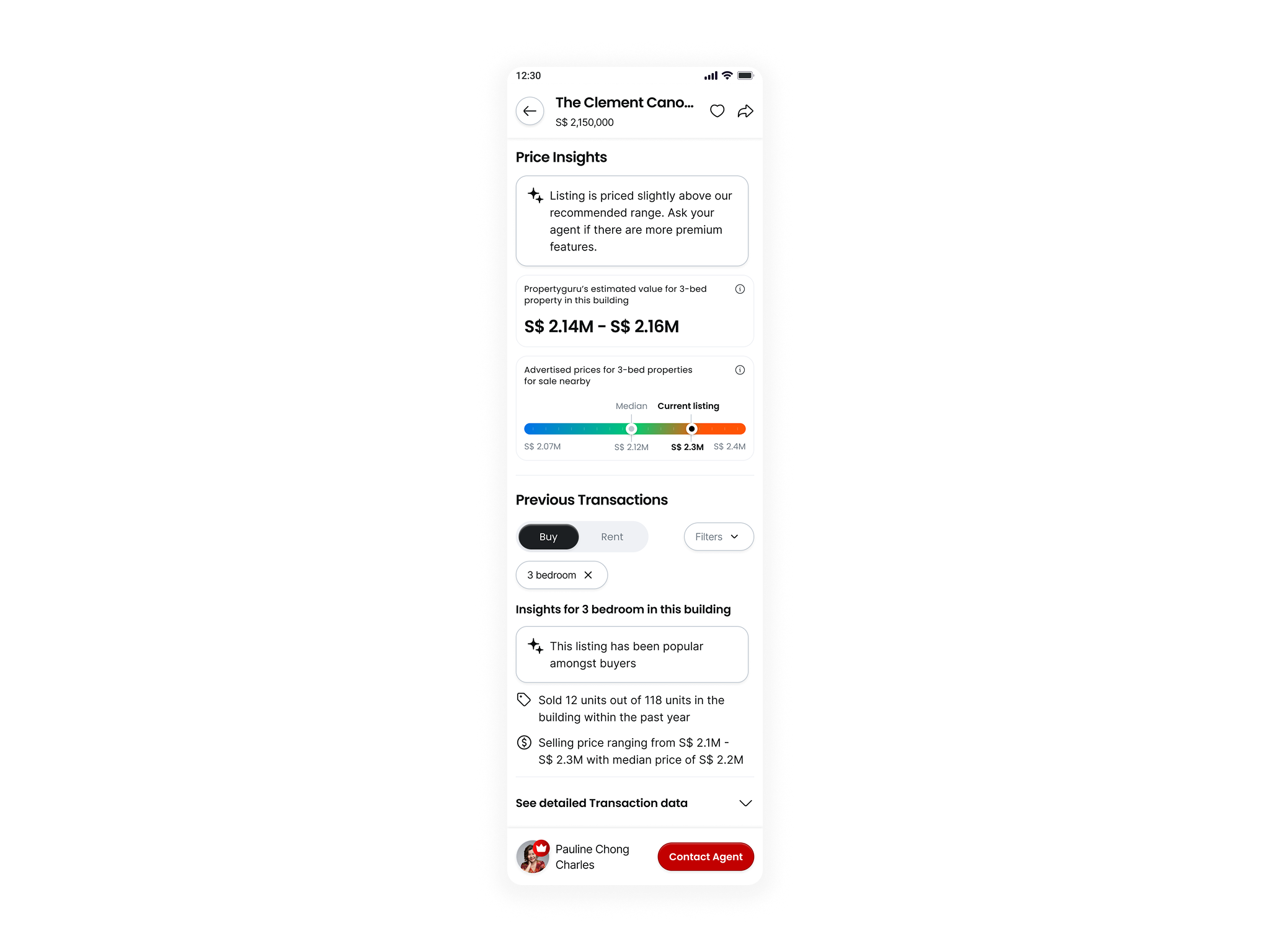
First iteration — full data surfaced on the listing page
06 — User Testing: Round 1
Too much, too soon
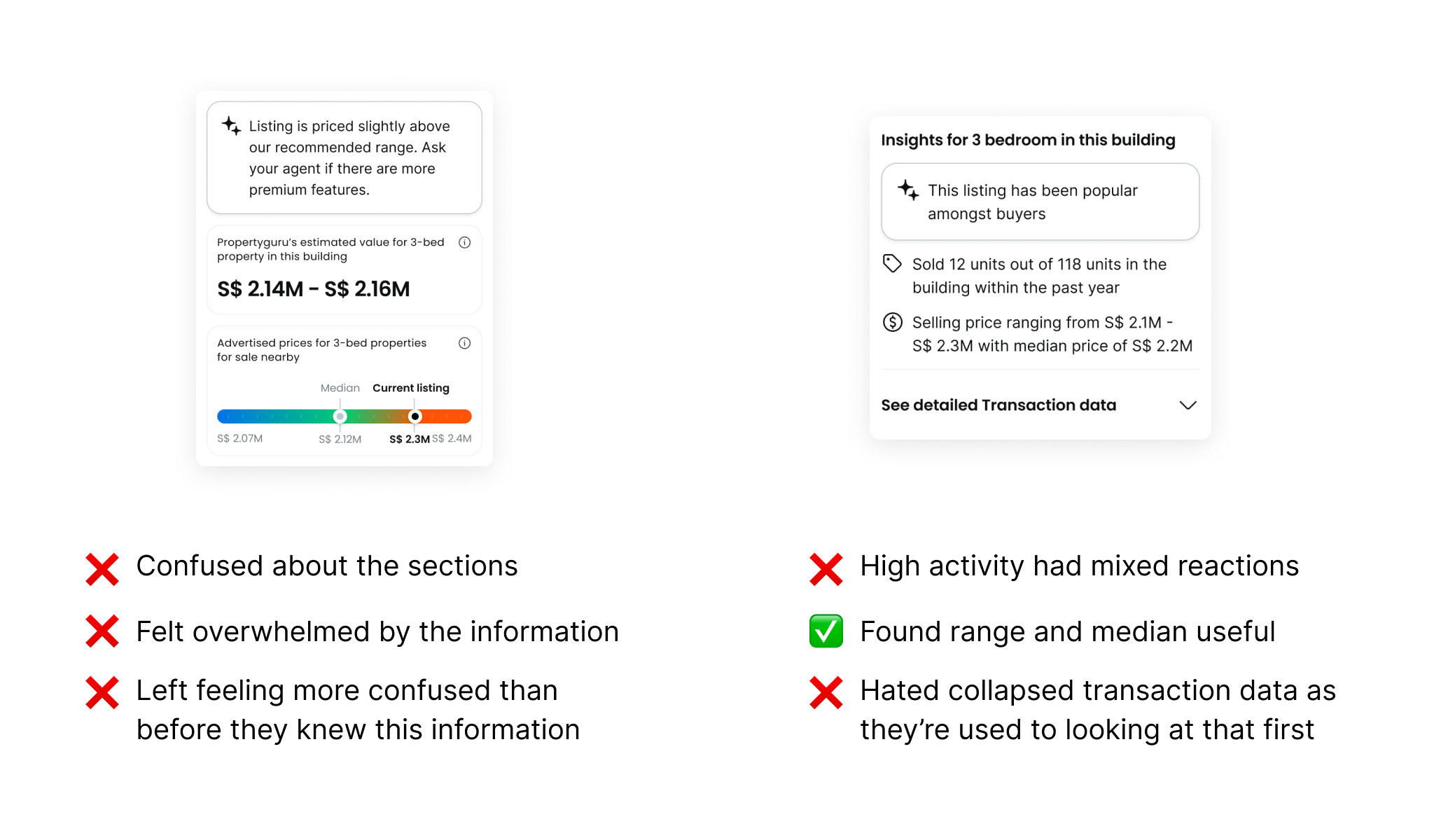
Testing synthesis from round 1
Users found the first design overwhelming — more confusing than not knowing the information at all. Two renters in Malaysia felt it was entirely unnecessary for their use case.
The data density was the problem. Users needed a clear, simple signal. We went back to the drawing board with a sharper brief: surface only what's essential, and let users pull more detail on demand.
07 — User Testing: Round 2
Less on landing, more on demand
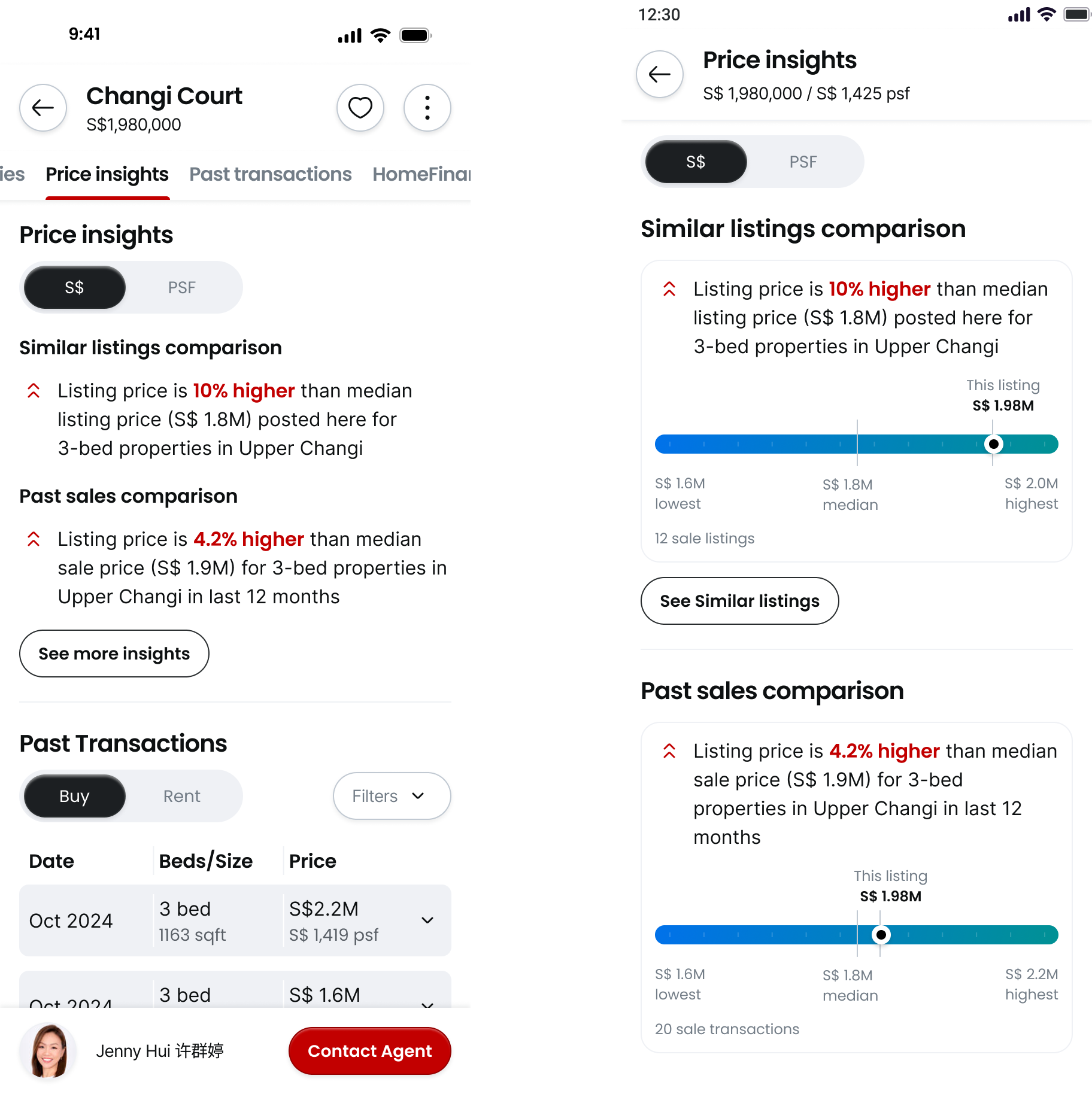
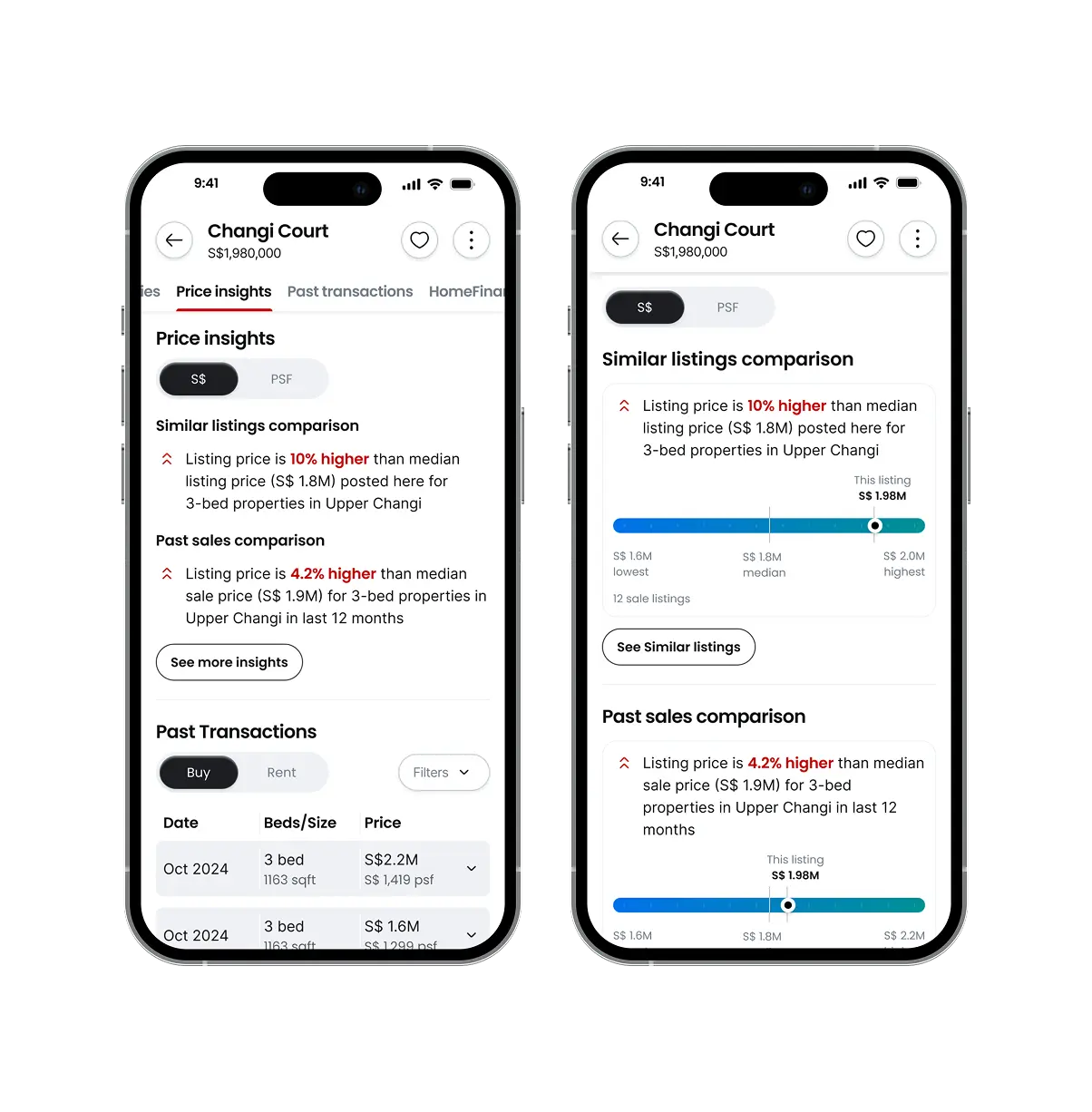
Refined design — essential info on landing, depth on request
The revised design made two major shifts:
- →On landing: Better copy, only the most essential signal, with additional data tucked behind a button. Past transactions were restored to their original position — users consistently understood this section well and rated it highly important.
- →Detail page: Richer visualisations to help digest information. Added a comparable listings view with price range and listing count — giving users meaningful context without drowning the landing experience.
08 — Outcome
Users felt confident. The data backed them up.
users found similar listing comparison useful
users found previous listing comparison useful
felt more confident negotiating after viewing the data
Comprehension was high across all participant types — from first-time renters to seasoned investors. The simplified landing experience meant users absorbed the core signal immediately, with the option to go deeper when they needed it.
09 — Release & Reception
Strong adoption from day one
adoption in the first month — well above expectations for a new information feature
users engaged with Price Insights in month one
daily users accessing price history post-launch — a feature people returned for
The numbers confirmed the hypothesis: when users are given clear, trustworthy pricing context, they come back to make decisions post the browsing phase. Price Insights moved PropertyGuru one step closer to being the most trusted property platform in South-East Asia.